
Teleprompter languages: 60 languages, one prompter that follows your voice
Read in any of 60 languages — or two at once — and the script scrolls as you speak. No language picker: Sayscroll identifies the languages in your script automatically.
Free demo — paste your script up to 700 characters. Subscribe for unlimited script length plus monthly speech hours.
As seen on
- USA Today
- NBC
- CBS
- abc
Sayscroll is a browser teleprompter that follows your voice word by word, and it does so in more than 60 languages: real-time speech recognition transcribes what you say, in the language you say it, and the matcher moves the script to keep the current word in place. There is no language setting to choose: Sayscroll identifies all languages inside your script automatically and listens for them from your first word. This page lists every supported language by script family, with what to expect from each — including the two cases where honesty matters most: Indic scripts, where matching ignores vowel signs, and Chinese, Japanese and Thai, which are transcribed but not yet followed word by word.
How language support works
Three things happen on every take, and they are the same in every language. Speech recognition turns your voice into words, marking each word with the language it detected. The matcher compares those words with your script after normalising both sides: accents and other diacritics are removed, everything is lowercased, and punctuation is dropped. Then the scroll follows the matched position — waiting when you pause, catching up when you re-read a line, and re-locking when you return from an ad-lib. The rules that decide whether a spoken word matches a script word are the same everywhere:
- Short words lean on their neighbours. Articles and particles are carried by the words around them rather than tracked on their own, so keep them in the line as you say them.
- Longer words tolerate small differences. Five letters or more allow one letter of difference; eight or more allow two. A dropped ending or a recogniser slip inside a long word does not stall the prompter.
- Diacritics never matter for matching. "año" and "ano", "schön" and "schon", "qué" and "que" all match the same spoken word. Keep the marks for your own reading; they cost nothing.
- Hyphens and apostrophes split words into pieces that are matched one after another: "anak-anak", "Türkiye'de", "l'ordinateur" each consume their parts in order.
- Numbers are matched as written. The recogniser often writes digits while your script has words, or the other way round, and there is no conversion — so write every number the way you will say it, in any language.
Matching runs in your browser on the live transcript, and the script itself never leaves your device. For the mechanics of pauses, re-reads and skips, see how a voice-controlled teleprompter works.
All 60 languages, grouped by script
Grouping by script is more useful than an alphabetical list, because the script — not the grammar — decides how well word-by-word following works today. Every language below is transcribed; the tables note what to expect from the matcher and link to the dedicated guide or localised site where one exists.
Latin script, spaced words: full word-by-word following
| Language | What to expect | Guide |
|---|---|---|
| Afrikaans | Close to Dutch in spelling; compounds are matched whole, so write them as one word | — |
| Albanian | Ë and ç are ignored for matching; keep them for reading | — |
| Azerbaijani | Latin alphabet with ə, ğ and dotless ı; dotted i and dotless ı are different letters, which longer words tolerate | — |
| Basque | Long agglutinated words are the easy case: a long word is hard to confuse with another | — |
| Bosnian | Č, ć, đ, š, ž are ignored for matching; write regional vocabulary as spoken | — |
| Catalan | Mixed Catalan–Spanish scripts keep tracking; the middle dot in l·l splits the word into two pieces | — |
| Croatian | As Bosnian; ije/je spelling differences do not throw the tracking in longer words | — |
| Czech | Háčky and čárky are ignored; short words such as "se" and "že" are carried by their neighbours | — |
| Danish | Æ, ø, å are ordinary letters; write numbers as words ("halvfjerds", not 70) | — |
| Dutch | Compound nouns are matched as single words; English loanwords track as spoken | — |
| English | Every accent; the largest training set | English teleprompter |
| Estonian | Long vowels and double consonants matter most in short words; longer words are forgiving | — |
| Finnish | Long agglutinated words are the easy case: eight or more letters allow two differences | — |
| French | Liaison is handled by the recogniser; "l'", "d'", "qu'" are matched as pieces | French teleprompter · French site |
| Galician | Tracks like Portuguese and Spanish; write your own variety as pronounced | — |
| German | Compounds matched whole; ß and ss are treated as the same; Austrian and Swiss Standard German included | German teleprompter · German site |
| Hungarian | Long suffixed words track well; vowel-length marks are ignored for matching | — |
| Indonesian | Reduplication with a hyphen ("anak-anak") tracks as spoken; English tech words track as spoken | — |
| Italian | Any regional accent; apostrophes ("l'idea", "un'ora") split into pieces | Italian teleprompter · Italian site |
| Latvian | Macrons and háčky are ignored; short function words are carried by context | — |
| Lithuanian | As Latvian; long inflected words are forgiving | — |
| Malay | Shares the Indonesian notes; Manglish scripts (English inside Malay) keep tracking | — |
| Norwegian | Bokmål and Nynorsk both track; write the form you speak | — |
| Polish | Ł, ą, ę, ś, ź, ż are ignored for matching; long words are forgiving | — |
| Portuguese | Brazilian and European; English loanwords | Portuguese teleprompter · Portuguese site |
| Romanian | Ș/ş and ț/ţ variants all match; write numbers as words | — |
| Slovak | As Czech; short words are carried by their neighbours | — |
| Slovenian | As Croatian; dual forms track as written | — |
| Spanish | Castilian and every Latin American variety; Spanglish | Spanish teleprompter · Spanish site |
| Swahili | Long agglutinated verbs track well; English and Arabic loanwords as spoken | — |
| Swedish | Every dialect and Finland-Swedish; compounds matched whole | Swedish teleprompter · Swedish site |
| Tagalog | Taglish scripts keep tracking; "ng" and "mga" are short exact-match words carried by their neighbours | — |
| Turkish | Suffix chains make long, forgiving words; dotted İ and dotless ı are different letters, so spell as you say | — |
| Vietnamese | Tone marks are ignored for matching, so words that differ only by tone are told apart by their neighbours; keep lines short | — |
| Welsh | Digraphs (ll, dd, ch) need no special handling; long place names track well | — |
Cyrillic script: full word-by-word following
| Language | What to expect | Guide |
|---|---|---|
| Belarusian | Ў and і are ordinary letters; write numbers as words | — |
| Bulgarian | Stress marks, if you add them, are ignored; short words are carried by their neighbours | — |
| Kazakh | Two alphabets are in use; write the script in one and, if the prompter stalls, try the other — the transcript comes back in one alphabet only | — |
| Macedonian | Ѓ, ќ, џ are ordinary letters; long words are forgiving | — |
| Russian | Ё and е match each other (the diaeresis is ignored); long inflected words are forgiving | — |
| Serbian | Cyrillic and Latin are both in use; use one consistently in the script and switch if the prompter stalls | — |
| Ukrainian | Ї, є, ґ are ordinary letters; apostrophes ("м'ясо") split words into pieces | — |
Greek: full word-by-word following
| Language | What to expect | Guide |
|---|---|---|
| Greek | Accents are ignored and final sigma is normalised, so ς and σ match; write Greek in the Greek alphabet — the transcript comes back in Greek letters, so Greeklish scripts do not match | — |
Right-to-left scripts: full following, rendered right to left
Arabic, Persian, Urdu and Hebrew are transcribed and followed word by word. In the prompter every paragraph takes its own direction, so a right-to-left paragraph reads from the right edge with punctuation where it belongs while an English paragraph in the same script stays left to right; the editor follows the direction of the script as a whole. Mirroring for beam-splitter glass flips the entire scroll area, direction included.
| Language | What to expect | Guide |
|---|---|---|
| Arabic | Modern Standard and dialects are transcribed; harakat (short-vowel marks) are optional and ignored for matching; write numerals as words ("ثلاثين", not ٣٠ or 30) | — |
| Persian | Use a Persian keyboard layout consistently so the Persian forms of yeh and kaf are used throughout; longer words track either way | — |
| Urdu | Nastaliq or Naskh rendering depends on your device fonts; matching is on letters, so either works; write numbers as words | — |
| Hebrew | Niqqud are optional and ignored for matching; Hebrew–English mixed scripts track, each word in its own language | — |
Indic scripts: following works, with one caveat
Bengali, Gujarati, Hindi, Kannada, Malayalam, Marathi, Punjabi, Tamil and Telugu are transcribed and followed. The caveat: in these scripts the vowel signs that sit around a consonant carry less weight in matching than the consonants do, so two short words that differ only in their vowel signs can look alike, and the surrounding words are what keep the position right. In practice tracking is stable through normal sentences; where it is most likely to hesitate is a line of very short, similar words. Write each language in its own script — the transcript comes back in the script the recogniser uses for that language, Devanagari for Hindi — and keep English words inside the same line in Latin letters, where they match as English.
| Language | What to expect | Guide |
|---|---|---|
| Hindi | Devanagari; Hinglish scripts keep their English words in Latin letters; numbers as words ("पचास", not 50) | — |
| Marathi | Devanagari, as Hindi; long compound words are forgiving | — |
| Bengali | Vowel signs ignored (see the caveat above); write numbers as words | — |
| Gujarati | Same caveat; English loanwords in Latin letters track as English | — |
| Punjabi | Gurmukhi; same caveat; short particles are carried by their neighbours | — |
| Kannada | Same caveat; long agglutinated words are forgiving | — |
| Malayalam | Same caveat; very long words are the forgiving case | — |
| Tamil | Same caveat; write Tamil in Tamil script, with English words in Latin letters | — |
| Telugu | Same caveat; numbers as words | — |
Hangul: full word-by-word following
| Language | What to expect | Guide |
|---|---|---|
| Korean | Words are spaced, so following works, and short words track reliably. Attach particles the way you say them; English loanwords in Hangul track as written | — |
Chinese, Japanese and Thai: transcribed, not yet followed word by word
These three languages are recognised and transcribed, but voice following is not available yet. These scripts write sentences without word boundaries, and the transcript comes back the same way, so the prompter cannot yet line up what you say with the words on screen. Word segmentation for these scripts is on the roadmap; until it ships, the honest answer is that Sayscroll is not the right prompter for a Chinese, Japanese or Thai script.
| Language | What to expect | Guide |
|---|---|---|
| Chinese | Transcribed; no word-by-word following yet | — |
| Japanese | Transcribed in kanji and kana; no word-by-word following yet | — |
| Thai | Transcribed; no word-by-word following yet | — |
Mixed-language scripts
Most real scripts are bilingual somewhere: an English product name inside a Hindi review, a quoted headline, a Spanglish intro for a US Latino audience, Taglish, Denglish. Sayscroll transcribes each word in the language you say it and matches it to the script, so the switch never breaks tracking and there is no toggle mid-take. Two rules make it reliable:
- Write each word the way you will say it, in its own script. A brand name pronounced in English is written in Latin letters even in the middle of a Devanagari or Arabic line.
- Paste the whole script before you start. Sayscroll identifies all languages inside your script automatically and listens for each of them from your first word, so a sentence or two in a second language is expected rather than a surprise. A single borrowed word is still picked up as you say it.
The six dedicated guides go deeper: Spanish, Portuguese, French, German, Italian and Swedish, plus the English teleprompter page for accents on the English side.
Writing a script the prompter reads well, in any language
Recognition transcribes what it hears, so spelling that mirrors speech tracks better than formal written language. The same five habits work in all 60 languages.
- Numbers as words, including years, prices and percentages, because digits and number words are never converted.
- Abbreviations as spoken: write "for example" or its equivalent rather than "e.g."; write an acronym as a word if you say it as a word, and as hyphenated letters if you spell it out.
- Loanwords and names in the language you will pronounce them, not the language of the surrounding sentence.
- One thought per line. Short lines keep the active word near the lens and make a re-entry after an ad-lib instant, because there is less text to find you in.
- Pauses as punctuation, not stage directions. A full stop or a dash is enough; "(pause)" is just another word to the matcher and does not create a pause.
Languages with their own site, and guides in English
Six languages have the whole product, blog and free tools localised: Español, Português, Français, Deutsch, Italiano and Svenska. For English-speaking creators who record in one of those languages, the dedicated guides above cover varieties, mixed scripts and writing tips. Every other language on this page uses the English interface — the normal case for bilingual creators, language teachers, and teams producing a video in a language they read but do not run their tools in.
Try it in your language
Paste a short script in any of the languages above on the free teleprompter page and press Start — no account, download or card. Sayscroll identifies the languages in your script automatically. Everything else — pauses, re-reads, ad-libs — behaves as described on the voice-controlled teleprompter page, and you can check your pace first with the WPM reading test.
From a few videos to all day
Usage-based monthly hours. Only live mic time counts. Cancel anytime.
Starter
-50% first monthFirst month, then $10/mo
Starter pricing, professional results
- 10 hours of teleprompter use per month
- Unlimited script length
- 99% accurate voice tracking
- 60+ languages, including mixed scripts
- Built-in video recorder
Creator
-50% first monthFirst month, then $20/mo
For creators and speakers who record daily
- 30 hours of teleprompter use per month
- Unlimited script length
- 99% accurate voice tracking
- 60+ languages, including mixed scripts
- Built-in video recorder
Pro
-50% first monthFirst month, then $50/mo
For studio professionals who go live all day
- 100 hours of teleprompter use per month
- Unlimited script length
- 99% accurate voice tracking
- 60+ languages, including mixed scripts
- Built-in video recorder
Built for creators & speakers
Sayscroll is by far the most versatile and useful teleprompter app I've tried so far (and I've tried them all). I love that I can use it on any of my devices, and it simply works, no complicated downloads, installation, or hardware requirements. Just works. The cherry on top is the level of customer service. They really consider every piece of feedback and suggestion. Great job, Sayscroll team!
We replaced a hardware prompter and a volunteer operator. It reads with the speaker and never runs ahead, even when a line gets repeated for emphasis.
As a non-native English speaker I pause a lot to find the right word. Fixed-speed prompters stressed me out — this one just breathes with me.
The voice tracking works extremely well, going off-script while speaking works so smoothly, and even switching between English and German has been great. So first of all: very well done.
The auto-pause is quietly brilliant. Silence doesn't burn my minutes, and resuming is one click. I use about two hours a month and it's plenty.
I jump between sections constantly during live demos. It finds where I am in the script every single time. Honestly feels like magic.
Frequently asked questions
Do I need to select a language before I start?
No. There is no language picker. Sayscroll identifies all languages inside your script automatically, and mixed-language scripts are handled word by word.
Can I mix two languages in one script?
Yes. Write each word the way you will say it and in its own script — an English product name stays in Latin letters inside a Hindi or Arabic line. Each spoken word is matched in the language it was recognised in, so the switch does not break tracking and there is nothing to toggle mid-take.
Does the teleprompter work with Chinese, Japanese or Thai?
Speech in those languages is transcribed, but word-by-word following is not available yet, because these scripts write sentences without word boundaries, in the script and in the transcript alike. Word segmentation for these scripts is planned. Until it ships, Sayscroll is not the right prompter for a Chinese, Japanese or Thai script, and we would rather say so here than let you find out on a take.
Does it support right-to-left languages such as Arabic and Hebrew?
Yes. Arabic, Persian, Urdu and Hebrew are transcribed and followed word by word. Each paragraph in the prompter takes its own direction, so right-to-left text reads from the right edge with punctuation in the right place, and an English paragraph in the same script stays left to right. Vowel marks (harakat, niqqud) are optional and ignored for matching.
Which languages track most accurately?
We do not publish per-language accuracy figures. What decides accuracy in practice is the same everywhere: clear audio from a microphone near your mouth, a script written the way you speak (numbers as words, loanwords as pronounced), and short lines. Widely spoken languages have the largest training data behind them; the one structural limitation is the Indic-script caveat above, where vowel signs carry less weight and tracking leans on neighbouring words.
My language is not on the list. Can you add it?
The list follows the languages our speech-recognition engine supports, and it grows with the engine. If you record in a language that is missing, tell us at support@sayscroll.com — knowing which languages people need is how we prioritise, including word segmentation for Chinese, Japanese and Thai.
Keep exploring
English Teleprompter That Follows Your Voice
Read in English with any accent — the script scrolls as you speak and waits when you pause. No training, no 'speak clearly' mode.
Free Teleprompter
Paste a script and start reading — no account, no download, no card, no watermark. Here is exactly what free includes.
Voice-Controlled Teleprompter
The script moves because you are speaking — it starts when you start, waits when you pause, and needs no remote, pedal, or operator.
Spanish Teleprompter With Voice Tracking
Read Spanish from Madrid, Mexico City, Buenos Aires, or Bogotá — the script scrolls as you speak and switches to English and back without a setting.
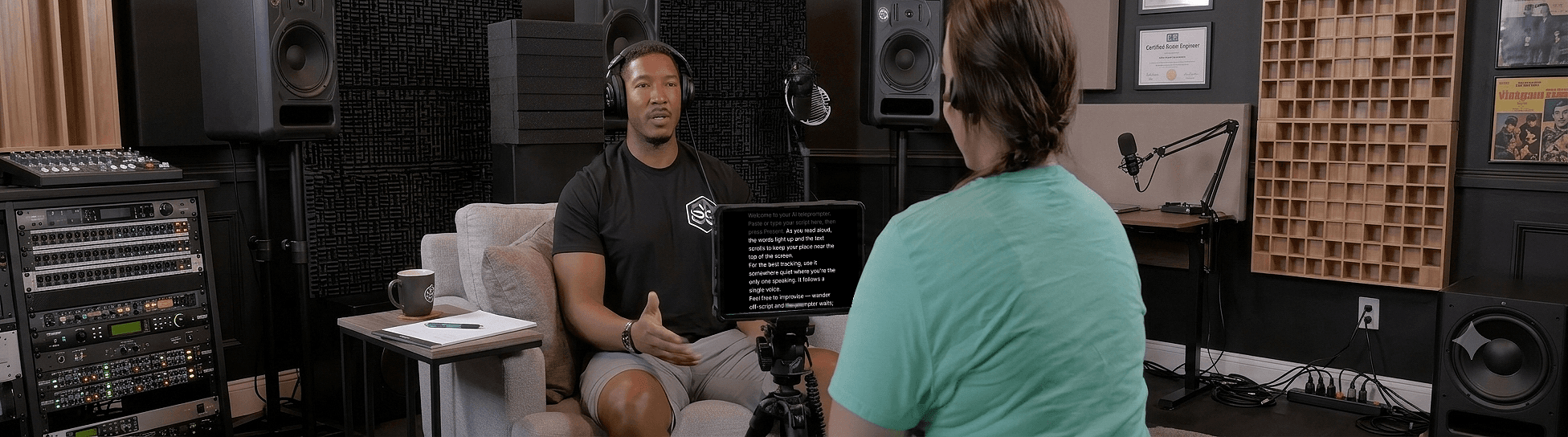
Speak naturally — Let the script follow you
The AI teleprompter that scrolls as you speak — in 60+ languages.