
Teleprompter vs Memorizing a Script: Which Gets a Better Take?
Memorizing a script feels like the honest option. No screen, no crutch, just you and the camera. In practice, memorized delivery is usually the stiffer of the two, because a large part of your attention is spent retrieving the next line instead of talking to the person watching. This is a fair comparison of the two approaches on the things that decide whether a take is usable, followed by the hybrid that most experienced presenters end up using.
Side by side
| Memorizing | Teleprompter | |
|---|---|---|
| Preparation time | Hours per minute of finished video | Minutes: write, format, paste |
| Word accuracy | Drifts; legal or technical wording suffers | Exact |
| Eye contact | Natural, until you search for a line | Natural if the text is near the lens |
| Retakes | Many, clustered at the hard passages | Few; mostly performance choices |
| Delivery | Can be excellent; often ‘recited’ | Can be excellent; ‘read’ if fixed-speed |
| Long scripts | Impractical past a few minutes | No limit |
| Last-minute changes | Painful | Edit and go |
| Cognitive load on camera | High: recall plus performance | Low: performance only |
What memorizing does to delivery
When you retrieve a memorized line, your eyes drift up or to the side, your pace goes even, and the emphasis flattens because the sentence is coming out as a unit rather than as meaning. Actors train for years to hide this. Presenters, founders, and teachers mostly do not, so the memorized take reads as recited. The failure mode is also expensive: one blank in the middle of a paragraph means a restart, and the blanks cluster on exactly the passages you struggled to learn.
What a teleprompter does to delivery
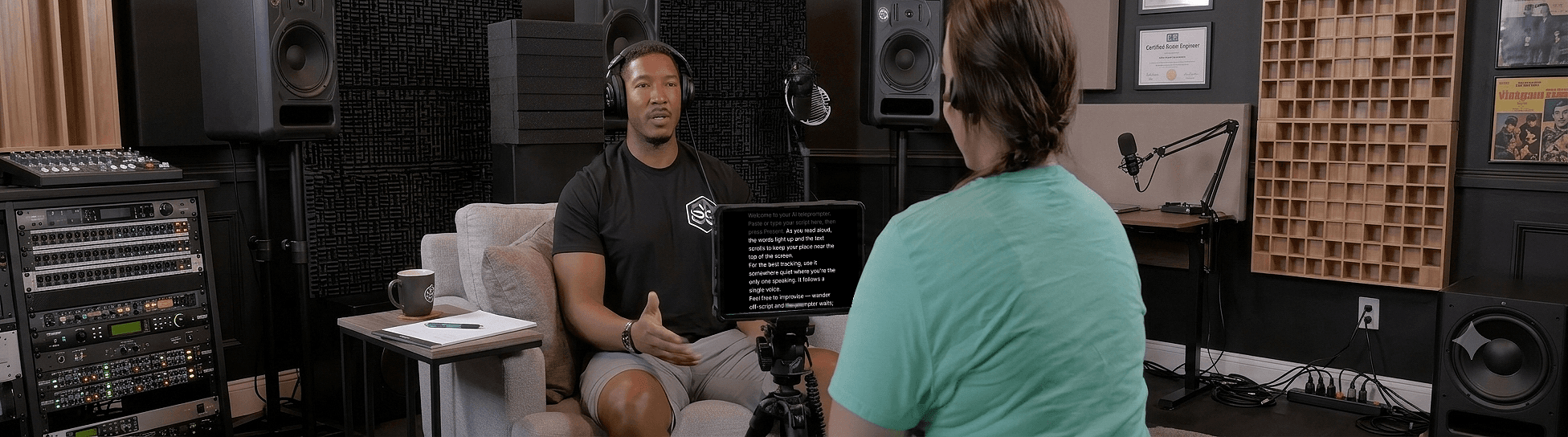
A prompter removes recall from the job, so all of your attention is available for the actual work, which is sounding like a person. The classic downside, the flat read, comes from fixed-speed scrolling that forces you to match the machine. A voice-controlled teleprompter removes that too: the script scrolls because you spoke, waits when you pause, and re-syncs when you ad-lib, so pace and emphasis are yours. Read naturally in phrases with the text near the lens and there is no tell. The reading naturally guide covers the technique.
When memorizing is worth it
- Short, repeated pieces. A fifteen-second hook you will say in fifty videos is worth knowing cold.
- Walking-and-talking shots where no screen can sit near the lens.
- Live stage moments that need free movement and no monitor, though many stages now have a downstage monitor precisely to avoid this.
- Performance in the acting sense, where inhabiting the line is the point.
The hybrid: know the shape, read the words
Most people who look effortless on camera are doing this. They know the structure of the piece well enough to look away from the script for an aside, a demonstration, or a laugh, and they read the exact words off a prompter for everything that has to be precise. With voice following, looking away costs nothing: the prompter holds while you talk off script and picks you up when you return to the text.
- Write the script for the ear and format it in short lines (how to write a teleprompter script).
- Read it aloud three times, off screen, until you could summarise every beat from memory.
- Load it into the prompter with the text near the lens.
- Record with the prompter following your voice, looking away whenever you want to.
- Learn the hook by heart if you will reuse it. Nothing else.
If the goal is simply to make videos without the memorization tax, the no-memorizing workflow walks through it end to end. If you are still weighing whether a prompter is worth having at all, start with why you need a teleprompter.
Frequently asked questions
Is it better to memorize a script or use a teleprompter?
For anything longer than a few sentences, a teleprompter gives a better take in less time: exact wording, fewer retakes, and your full attention on delivery. Memorize only short repeated pieces like a channel hook.
Do professionals memorize or use teleprompters?
Newsreaders, hosts, and most corporate presenters read from a prompter; actors memorize because performance is the job. Many YouTubers use a hybrid: the structure memorized, the words read from a voice-following prompter.
Will a teleprompter make me sound like I'm reading?
A fixed-speed one can, because you have to match its pace. A voice-following prompter scrolls at your pace and waits when you pause, so delivery stays conversational. Keep the text near the lens and read in phrases.
How long does it take to memorize a five-minute script?
Several hours for most people, and the result still tends to sound recited. The same script pasted into a teleprompter is ready in under a minute, leaving the time for rehearsal.
Keep reading
How to Make Videos Without Memorizing a Script
You do not need to memorize anything to look fluent on camera. Here's the end-to-end workflow — script, setup, record, edit — that replaces the memorization tax.
Why You Need a Teleprompter
The real reasons a teleprompter pays off — confidence, fewer retakes, faster editing, exact wording — who it's for, and why voice following removes the usual downside.
How to Read a Teleprompter Naturally (Without Sounding Like You're Reading)
The read-aloud sound comes from a few fixable habits: eyes that scan, a pace set by the machine, and breath that never lands. Here's how to fix each one.
Related pages
Voice-Controlled Teleprompter
The script moves because you are speaking — it starts when you start, waits when you pause, and needs no remote, pedal, or operator.
Teleprompter for Speeches & Public Speaking
Land every line with your eyes up, not buried in a page.
Free Teleprompter
Paste a script and start reading — no account, no download, no card, no watermark. Here is exactly what free includes.
Speak naturally — Let the script follow you
The AI teleprompter that scrolls as you speak — in 60+ languages.